Every capability,
grouped by signal.
Atlas is designed around four signals (vehicles, people, zones, crowds) on one on-device platform. The vehicle signal ships first; the rest are in the pipeline. The platform stays the same; what changes is which signal you switch on at which camera.
Vehicles
Every plate read, checked against VAHAN, and logged at the gate.
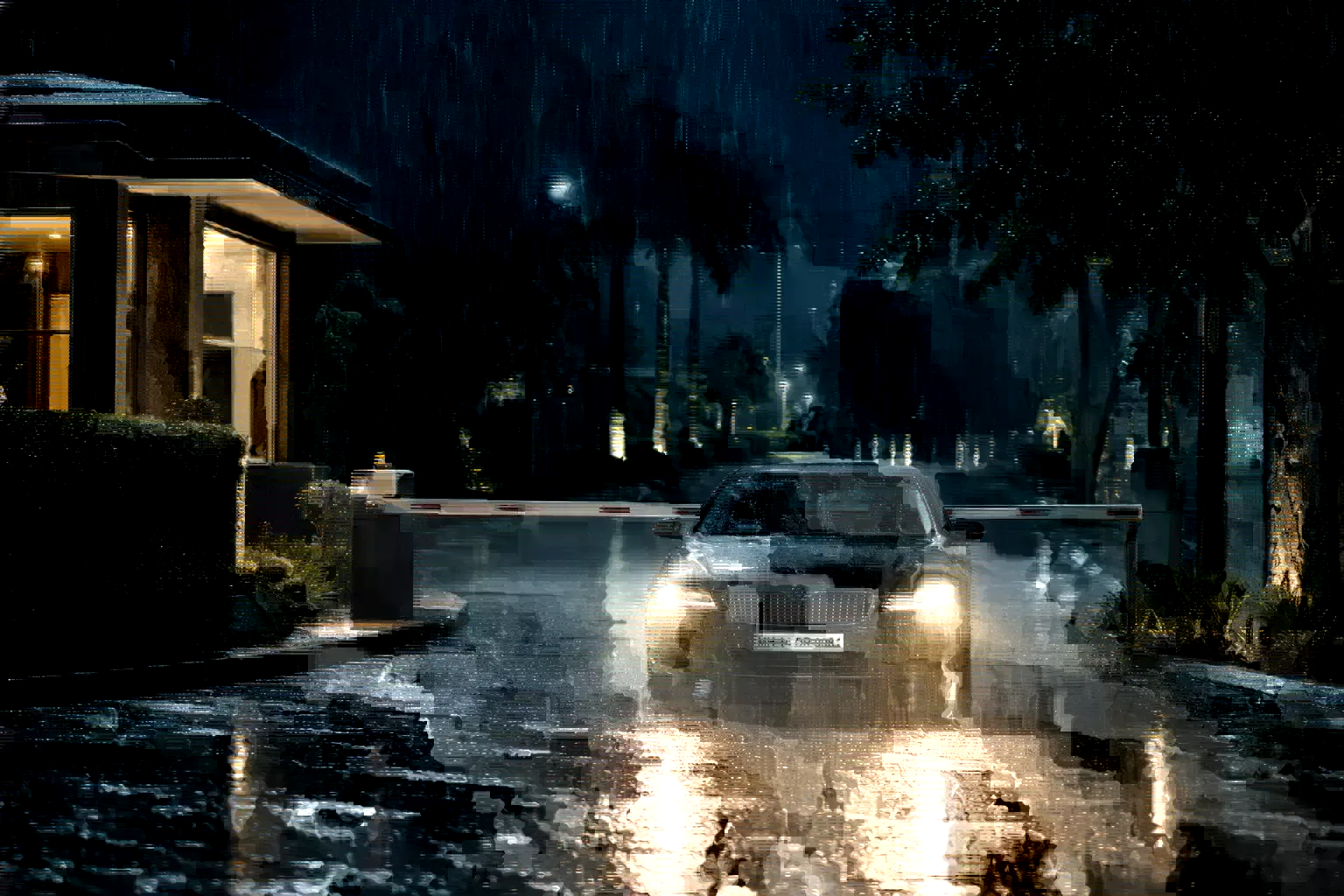
Indian-plate recognition tuned for monsoon glare, headlight bloom, and night fog. Motion-gated and sharpest-of-burst, so it only reads a frame clear enough to trust.
Every plate is checked against the national vehicle registry (owner, make, and insurance status), and returning vehicles are recognised by their plate.
Atlas fuses the plate read with VAHAN make and entry pattern into one identity with a confidence score, so a cloned plate that doesn't match its vehicle alerts the guard.
A flagged plate pings the guard's phone over WhatsApp within seconds of the read. As more gates join, a vehicle blacklisted at one site is known at the next.
Resident and vendor lists live on the edge box. Edits are instant, with no cloud round-trip. A VIP plate is cleared at the gate before the car stops.
Every entry and exit is written to an access-controlled, encrypted audit log, searchable in seconds for a parking dispute, an FIR, or a DPDP audit.
People
Intrusion logic that never stores a face off the box.
Purpose-built detection tuned for Indian uniform sets, monsoon ponchos, and helmets, designed to run on the same edge box as the vehicle signal.
Polygon-bounded zones with time-of-day rules. An unknown person inside a restricted zone at 2 am is an alert; the same crossing at 2 pm is a log entry.
Optional RFID or QR pairing. Atlas can tell whether the person crossing the line is a guard, a contractor, or unknown, without storing a face.
A person loitering inside a sensitive zone for longer than the configured window pings the guard station, WhatsApp, or the society-app webhook.
Pose-based alerts for fallen or stationary individuals, designed for lobbies, parking decks, and senior-living gates.
No face embeddings persisted off-device. Biometric pairing is opt-in per site, never default, and every retention decision is in the audit chain.
Zones
Draw a polygon. Set a rule. Atlas raises a local alert the moment it's broken.
Click corners on the camera image to draw any zone shape. Per-camera, per-time-of-day, per-day-of-week rules.
If <object> enters <zone> during <window>, then <action>. Actions: log, alert the guard, webhook, or society-app integration.
Zones can be nested or exclusive. A car entering the visitor lane that drifts into the resident-only ramp triggers a different rule.
From boundary cross to guard-station ping over the local network: no cloud hop, no Indian-internet variance, no outage downtime.
Every rule edit is signed and timestamped. An auditor can see who changed what, and when.
Replay any incident frame-by-frame to tune the polygon, reducing false positives without re-training a model.
Crowds
Occupancy, flow, and dwell: aggregate-only, no identifiers off the box.
Per-zone headcount with smoothing, for lobbies, gyms, clubhouse capacity, and parking decks.
Net inbound vs outbound across any boundary. Catches reverse-flow at one-way ramps and after-hours exits.
Surfaces a group that has been stationary in the wrong place for too long, without naming anybody.
Fire-safety occupancy ceilings raised as alerts to the duty desk before a crowd becomes a violation.
Per-event profiles for Diwali, Ganpati, and New Year, suppressing normal-traffic alerts and sharpening density thresholds.
Designed to plug occupancy and density events into the building-management system, fire panel, or duty-app stack.
The shared edge.
The four below apply to every signal. They are what makes Atlas a platform instead of four point products.
How the signal flows: the plate is read at the gate, processed on the edge box on your site, checked against the VAHAN national registry, and the guard is alerted within seconds.
Every model runs on one small edge box installed in the guard cabin. Raw video never leaves the property.
The edge box plugs into the cameras you already paid for. We replace the brain, not the rig. A gate is commissioned in days, not a rip-and-replace project.
Every model and OS update is cryptographically signed. Every event lands in an access-controlled, encrypted audit log.
Configurable per site, defaulted conservative. No PII leaves the box.
More cameras give you more to review. An edge brain acts.
| Traditional CCTV | Atlas | |
|---|---|---|
| What it does | Records footage for review after something goes wrong. | Reads the gate in real time and acts as it happens. |
| Vehicle identity | None — a plate is just pixels on a recording. | Reads the plate and checks it against the VAHAN registry. |
| Your cameras | Rip-and-replace projects to add any intelligence. | Runs on the cameras already on site. Live in days. |